


Bob Mackin
NDP leader David Eby’s snap election means fewer places to vote on Oct. 24.
A resident of North Vancouver-Seymour, an NDP-held riding since 2020, worries it could be a factor in who wins and loses.
The official Elections BC list shows the riding had 13 locations to vote on Oct. 19, 2024.

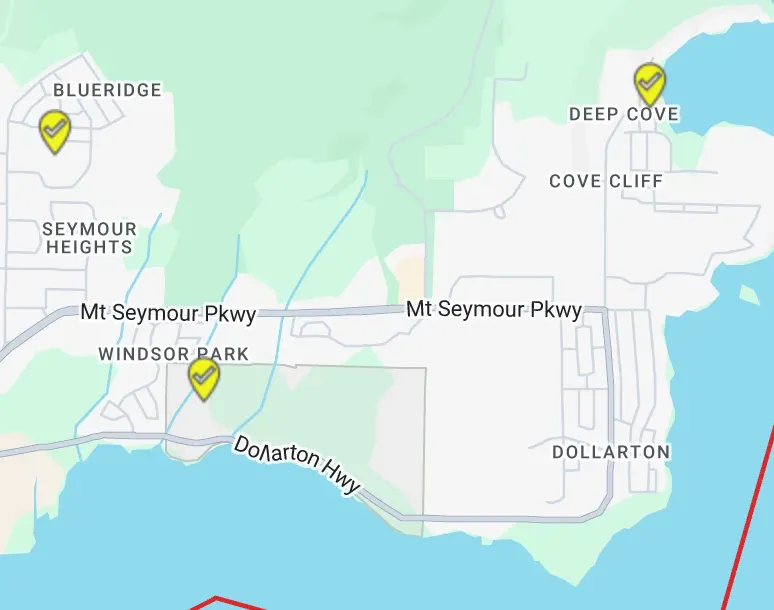
Voting locations on Oct. 24, 2026 in the eastern end of North Vancouver-Seymour. (Elections BC)
But, in 2026, only nine. A reduction of 30%.
Eby called the election on Sept. 22, two years ahead of the 2028 fixed date. The campaign overlapped the Oct. 17 local government elections, which meant Elections BC suddenly had to compete for space.
Peter Teevan, who is vice-chair of the Seymour Community Association, appealed on Oct. 16 to Elections BC to restore places used in 2024 for advance voting and final voting.
“Dorothy Lynas School and Sherwood Park Elementary are normally used and they should be activated now,” Teevan wrote to Elections BC.
He also proposed Elections BC set-up a mobile voting station at Parkgate Community Centre, which had been a 2024 location.
Teevan worries that neighbourhoods that lean toward the incumbent MLA, the NDP’s Susie Chant, are being well-served and ones that do not are being suppressed. He estimates as many as 8,000 people in the “polling desert” will have to travel further to vote.
Province-wide, Elections BC reported 891,348 early voters over six days, down 110,656 from 2024.
What Elections BC said
Voting locations on Oct. 24, 2026 in the eastern end of North Vancouver-Seymour. (Elections BC)
Elections BC responded Oct. 20 to Teevan.
“Voting locations are selected to ensure an accessible voting experience for communities across the province. However, due to the availability of locations at the time of an election call, there may not be spaces available in all communities which are appropriate to host a voting location in compliance with our standards.”
Elections BC’s Where to Vote app and toll-free hotline 1-800-661-8683 are recommended for anyone with questions about their local polling station.
Distance can be a factor
In a 2014 interview, Marc-David Seidel, Professor of Organizational Behaviour and Human Resources at the University of British Columbia, said greater time and distance can impact voting.
“Perceived distance to a polling station can be the deciding convenience factor in choosing to vote for many people, and distance can disproportionately impact voting behaviours based upon age and physical mobility — suppressing voter turnout disproportionately for certain demographic groups,” Seidel said.
Academic research backed him up
In Location, Location, Location: Precinct Placement and the Costs of Voting, Moshe Haspel and Gibbs Knotts found “distance has a statistically significant impact on the voting decision.”
In Distance, Turnout, and the Convenience of Voting, University of Maryland’s Joshua J. Dyck and James G. Gimpel found greater distance to election-day polls “increases nonvoting, at least to a point, but the effect is nonlinear.”
Some voters in outlying areas do adapt, by voting by mail or attending advance voting stations.