



Bob Mackin
Ontario and British Columbia’s information and privacy watchdogs publicly called May 4 for Toronto and Vancouver officials to follow all laws governing surveillance systems during FIFA World Cup 26.
“Our city governments, police services, and other agencies are making necessary efforts to ensure the safety and security of athletes, fans, visitors, and residents going about their daily lives during the events,” said the joint statement from Ontario’s Patricia Kosseim and B.C.’s Michael Harvey.
“These efforts must include rigorous consideration of people’s privacy and information rights. This is particularly important when purchasing and using surveillance technologies meant to keep people safe.”

Ontario commissioner Patricia Kosseim (left) and B.C.’s Michael Harvey. (OIPC BC)
Their six-point statement said: all technologies and techniques must be legally authorized, necessary and proportionate; surveillance signage should be displayed in a clear an apparent manner; World Cup-related surveillance installations should be time-limited and video footage taken during the event must not be retained longer than necessary; and all third-party contracts must addresses accountability.
“Municipalities, police services and other agencies involved in preparing for and holding the FIFA World Cup must have clearly delineated roles and responsibilities from the early stages of planning to the closing out of the games. This is to ensure seamless governance and accountability for the collection, use, retention and secure disposal of personal information, including when in the hands of third-party contractors.”
Vancouver playbook
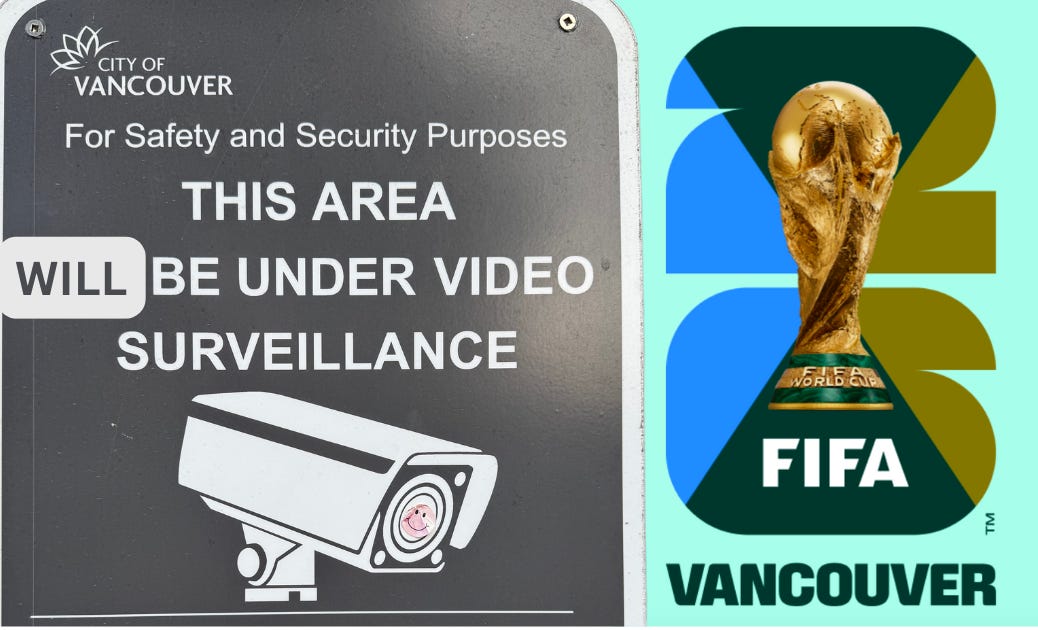
City of Vancouver is deploying a temporary surveillance camera network in six zones: around the training sites at Killarney and the UBC National Soccer Development Centre; the Hastings Park FIFA Fan Festival site; match-day spectator route to B.C. Place Stadium; the downtown hotel zone and the Granville Street and Commercial Drive entertainment zones.
Its key “digital infrastructure and innovation” contractor is Telus, hired for $12.9 million to install and operate WiFi, internet services and closed circuit television.
When it advertised the contract, the city said it planned to deploy up to 200 new remotely monitored cameras and integrate as many as 1,000 existing cameras to meet FIFA security requirements.

More than 200 cameras will be watching in 2026 City of Vancouver)
City of Vancouver and the Vancouver Police Department will oversee and operate the network.
“Other agencies may view information only when operationally required and cannot retain footage without approval,” said a statement from city hall.
The city said the network is fully compliant with the Freedom of Information and Protection of Privacy Act and city policies.
“It includes strict, role‑based access controls with audit logging, time-limited retention, secure disposal of recordings, and an express prohibition on facial recognition, biometric analysis, or any form of automated identification of individuals. All footage will be transmitted on secure Canadian infrastructure, stored locally, and will not transfer over international borders.”
Vancouver hosts seven matches at B.C. Place Stadium between June 13 and July 7, but festivities will continue. The city vows to turn-off all cameras after the July 19 final and fully decommission the network.
Security breach
The privacy watchdogs’ statement came, coincidentally, the same day that someone breached security at what is supposed to be one of British Columbia’s most-secure facilities: Vancouver International Airport.
Richmond RCMP responded around 4 a.m. and arrested a man who had climbed a barbed wire fence to the apron area and hid in the wheel-well of a Porter Airlines jet near the main terminal.