



Oscar Connolly-Connell
Vancouver’s host agreement with FIFA is transforming how public space is used during the World Cup, from the temporary closure of Hastings Skatepark to new restrictions on street vending within two kilometres around B.C. Place Stadium.
Hastings Skatepark has long been a renowned spot in East Vancouver, predating the city’s legalization of skateboarding on streets in 2003. Its iconic, 11-foot bowls and street sections attract riders seeking challenging lines and high-speed runs.

(Vancouver Skateboard Coalition)
On sunny afternoons, the bowls normally hum with motion. Spectators gather around its edges, watching pro riders meander and glide as they perform stylish maneuvers.
For skaters, this is more than just a slab of concrete. It’s a cathartic outlet and a tight-knit community.
Vancouver has 10 other skateparks, but “for us, nothing compares to Hastings Skatepark,” says Oliver Tennant, director of the Vancouver Skateboard Coalition.
The skateboarding community’s response
This closure has triggered backlash from Vancouver skaters, with the Vancouver Skateboard Coalition as a crucial advocate for the skatepark, closed due to the heavily secured FIFA Fan Festival at Hastings Park.
“FIFA is taking away a very important public space, displacing thousands of skaters,” Tennant says.
“We met with FIFA in person, and it was a pretty disappointing meeting because it was less of an open discussion with the community to find a creative solution, and instead they just informed us there’s nothing they can do.”

PNE Amphitheatre, centrepiece of FIFA Fan Festival Vancouver. (Mackin)
Tennant explains that film companies pay the Coalition $4,000 per day for exclusive access to the skatepark. This money is reinvested in Vancouver’s skateboarding community. Hastings Skatepark, Oliver notes, urgently “needs maintenance due to constant use.”
The budget for the new amphitheatre at Hastings Park, the centrepiece of the city’s official FIFA watch party, has tripled in cost to $183 million.
Even so, Coun. Mike Klassen, in response to the closure, prioritized the Coalition’s capital request to resurface, repaint and re-coat Hastings Skatepark. It is being allotted $500,000 in the city’s 2027-2030 capital plan.
“My personal feeling is that I want to reward a community that’s done so much for itself,” Klassen says.
Meanwhile in downtown, another community carries out its daily rituals on public land.
At 1 p.m. on Granville Street, office workers loosen ties while tourists hover nearby, and construction workers count their loonies in line.
“Next! Smokie?”
Buns—ketchup, onions—everything runs efficiently. This routine began in the 1990s and, with the same sidewalk, vendors and hot-dog stands enduring to this day.
Still, as the smoky steam shrouds over Granville, so does uncertainty for the weeks ahead.
An uncertainty stemming from the FIFA Controlled Area, spanning a 2 km perimeter around B.C. Place and a 100 metre radius around the PNE until July 20.
“Yeah, my buddy, Big Mike, that’s what we call him, got told to move, ” says Nikolay Banchev, a vendor at Mr. Tube Steak, half-laughing, half-not. “The FIFA committee says he’s inside their clean zone. We’re lucky. We’re just outside.”
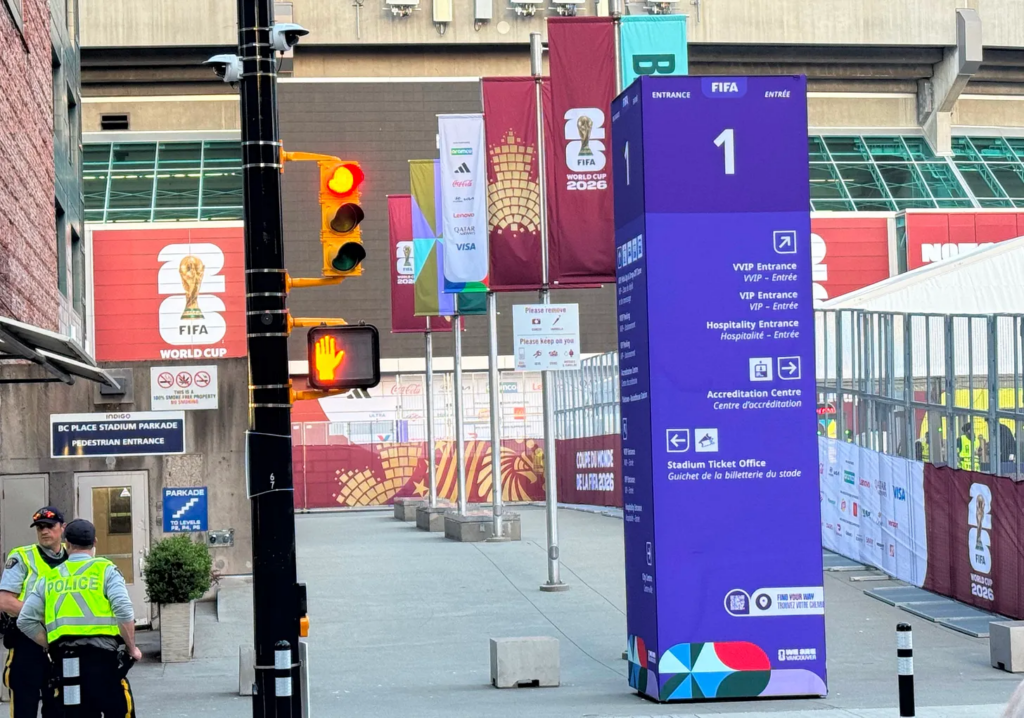
Heavily secured Terry Fox Plaza at B.C. Place, with FIFA signage, including official sponsor logos. (Mackin)
“This relocation will impact my business. This spot near B.C. Place gets more foot traffic, especially in summer, “ says Mike Ramanauskas, owner of Stadium Gourmet.
Being forced to move outside the “clean zone” means facing fewer customers, which will could lead to a drop in sales and income during the busiest season.
Vending is already volatile, Ramanauskas explains.
“This disruption comes as it gets harder to be a food vendor in Vancouver. People don’t see the tight margins. In the last 10 years, a 12-pack of sausages has tripled in price, not to mention the rising gas prices,” Ramanauskas says.
A fish called FIFA
Other retailers cannot simply move elsewhere temporarily.
Aquariums West is located a throw-in from the VIP gate on Terry Fox Plaza at B.C. Place. It is closed on the seven match days when transportation and security restrictions are heaviest. It will feel the impacts throughout the period due to additional barriers, parking restrictions and traffic detours while FIFA controls the stadium.
The company informed customers with an image on the website of hungry piranhas surrounding a soccer ball.
“And, yes, piranhas are in stock,” it says.

AquariumsWest.com
Two communities use public space differently: one for recreation, the other for making a living. Both will face direct disruptions — skaters losing access to their skatepark, and small businesses losing access to high-traffic areas — when city spaces are repurposed for FIFA.
Human rights concerns
These “clean zones” are also part of a contentious tradition during FIFA tournaments to beautify host cities and protect the brands of FIFA sponsors from competitors, with a documented history of human rights abuses.

Sign warns about the vast FIFA World Cup surveillance zone in downtown Vancouver. (Mackin)
According to Human Rights Watch, during the 2022 Qatar World Cup, vulnerable residents, including the homeless, experienced rights violations within such zones. Vancouver’s clean affects the Downtown Eastside, so concerns have been raised that it may displace homeless and low-income communities.
Vancouver published its final human rights action plan on May 25. On four pages it cites Canada’s Charter of Rights and Freedoms. The plan is also the catalyst for more than $182,000 spending on 10 non-profit contractors to prevent or mitigate any street-level issues for the homeless and those vulnerable to exploitation, including human trafficking.
Hyper-local impacts may be downplayed or even overlooked. Yet, this situation highlights a key dynamic.
“The city has greater bargaining power than it chooses to exercise, ” says Bob Mackin, editor of theBreaker.news. “In many ways, FIFA wants to be here more than here wants FIFA.”
Oscar Connolly-Connell is a freelance journalist based in Vancouver.
Subscribe to theBreaker.news on Substack. Find out how: Click here.