



Bob Mackin
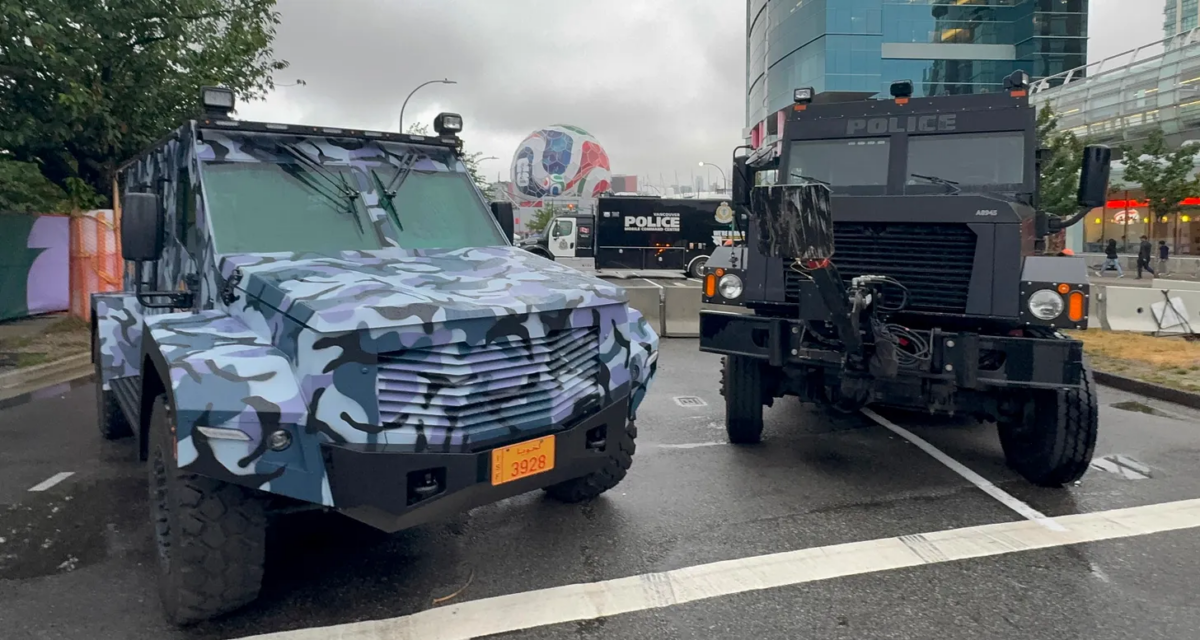
Qatar paramilitary personnel parked two of their camouflage vehicles at the security roadblock near Main Street-Science World SkyTrain station on July 2, the primary portal for ticket holders to the Switzerland/Algeria FIFA World Cup match.
Unarmed, but uniformed, members of the Ministry of Interior’s Internal Security Force, also known as Lekhwiya (brother in Arabic), have had a presence around B.C. Place Stadium and city streets since the World Cup began.
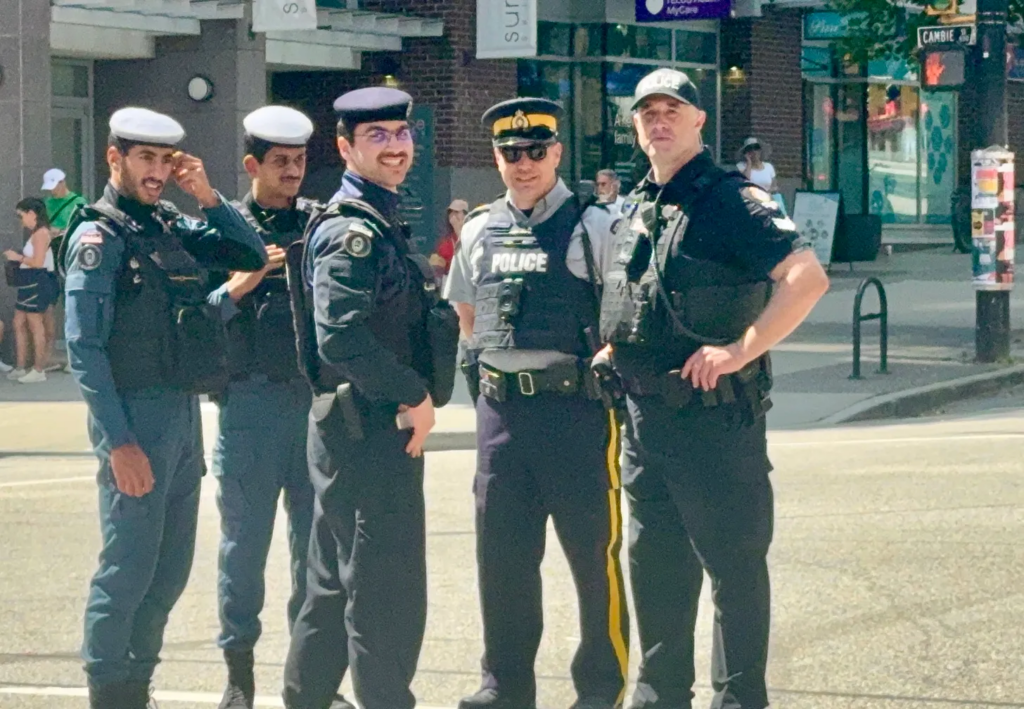
Qatar Security Force officers with RCMP and Vancouver Police Department officers near B.C. Place Stadium on June 24, 2026. (Mackin).
In late May, two Qatar Emiri Air Force C-17 Globemasters flew in and out of Vancouver International Airport. On June 10, another arrived at Abbotsford International Airport.
Qatar fell 6-1 to Canada in the group stage at B.C. Place on June 17. The officers have remained in Vancouver, which completes hosting duties with the July 7 round of 16 match between Colombia and Switzerland.
Const. Megan Lui, a Vancouver Police Department public information officer, told theBreaker they are “here to observe and take part in training opportunities.”
“None of the Qatari personnel in Vancouver to observe FIFA security operations are embedded with VPD or RCMP,” Lui said.
A statement from Robin Percival, of the RCMP headquarters national communications and public affairs office, said the World Cup visit is about “knowledge-sharing and training activities.”
“Qatari personnel participating in FIFA-related events and training are present in a collaborative and observational capacity,” Percival said.
More from the Mounties
“Policing and security operations in Canada remain the responsibility of Canadian law enforcement agencies and police of jurisdiction,” Percival said. “Canadian law enforcement agencies maintain operational responsibility and decision-making authority for policing and security operations conducted in Canada. Any international participation associated with FIFA World Cup 2026 preparations is conducted within established Canadian frameworks and in support of collaborative preparedness activities.”
Instead of ICE
Vancouver Coun. Pete Fry (Green) and Coun. Sean Orr (COPE) co-authored a February motion opposing U.S. Immigration and Customs Enforcement agents being involved in FIFA security.
“We were told that we were fear mongering by VPD Chief Rai,” Orr said by email. “During the reading of that motion, Councillor Montague stated that ‘U.S. agencies have zero jurisdiction, zero authority to conduct law enforcement in Canada’, so you’d think that would apply to all foreign nations. But Qatar isn’t just another foreign nation, it’s one that oversees numerous human rights abuses.”
Orr said Vancouverites deserve clarity about policing of public spaces during the World Cup and must be reassured that Canadian laws and the constitution prevail.
Qatar Security Force members met with B.C. RCMP brass, including Commanding Officer Dwayne McDonald at E Division headquarters in Surrey. (@SeCommittee2022/X)
“Sportswashing” allegations
Human Rights Watch (HRW) said Qatar and FIFA failed to compensate abused workers, many of them migrants, who made the 2022 World Cup possible.
“Qatari laws discriminate against women due to abusive male guardianship policies and against lesbian, gay, bisexual and transgender individuals,” said HRW’s 2025 report. “Authorities restrict free expression and have strengthened their surveillance capabilities.”
Political science professor Jules Boykoff, author of “Red Card: The 2026 World Cup, Sportswashing, and the FIFA Greed Machine,” said Qatar’s 2022 World Cup hosting helped the gas-rich kingdom soften its image, boost tourism and become a diplomatic force in the Middle East.
“I mean, they’re working on the deal between the United States and Iran right now, and alongside Pakistan,” Boykoff said on theBreaker.news Podcast. “When people ask themselves, does sportswashing work? They often mean, does it work on an international audience? And I think the case of Qatar shows that it has worked on an international audience.”
How it happened
Qatari personnel and vehicles on Vancouver streets are a legacy of Prime Minister Mark Carney’s January trade mission to Doha and meeting with Qatar’s ruler, Sheikh Tamim bin Hamad Al Thani.
The emir’s brother, Sheikh Khalifa bin Hamad bin Khalifa Al Thani, is the Minister of Interior and Commander of Internal Security Force.
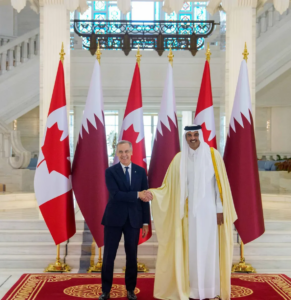
Prime Minister Mark Carney and the Emir of Qatar on Jan. 18, 2026 in Doha. (PMO)
Carney announced the two countries would “exchange security-related best practices and lessons learned in preparation for the FIFA World Cup 26, as Canada, Mexico, and the United States prepare to co-host this global sporting event.”
In May, Foreign Minister Anita Anand was in Doha, and described Canada and Qatar’s relationship in three words: “Friends. Allies. Partners.”
B.C. Premier David Eby said Qatar would be a target of the province’s World Cup-related economic development program.
On June 25, Public Safety Minister Gary Anandasangaree signed a five-year memorandum of understanding on public safety cooperation with Qatar to “advance police-to-police cooperation.”
The two countries agreed to work together to “prevent, detect and combat transnational crime, including human trafficking, financial crime, money laundering, cybercrime, terrorism and its financing, and the illicit trafficking of firearms and drugs.”
The Qatar Embassy in Ottawa did not respond for comment.
What next?
Even after the World Cup, Qatar’s military will be relatively close by.
U.S. and Qatari officials announced last October a plan to build a Qatari Emiri Air Force facility in Idaho’s Mountain Home Air Force Base, some 1,100 kilometres southeast of Vancouver.
Coincidentally, on Canada Day, U.S. President Donald Trump took delivery of the Qatar-gifted, Boeing 747, worth US$400 million, for the Air Force One fleet.
Subscribe to theBreaker.news on Substack. Find out how: Click here.