




Bob Mackin
All eyes on the temporary, hybridgrass pitch at B.C. Place Stadium when the FIFA World Cup kicks-off. But some eyes will be focused on the skies.
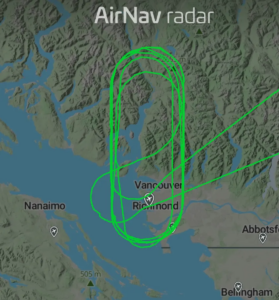
Open source map showing the flight of the U.S. Air Force stratoanker on June 3, 2026 over the Lower Mainland, as part of a pre-FIFA World Cup training exercise. (RadarBox)
NORAD, the joint Canada/U.S. North American Aerospace Defense Command, held its final Canadian exercise on June 3 above the Lower Mainland. Few, if any, morning commuters saw it, due to the overcast skies. But the Boeing KC-135 Stratotanker (tail number 63-8884) from Fairchild Air Force Base in Spokane, Wash., was particularly audible during its passes over the North Shore mountains and visible on open source flight tracker apps.
NORAD Capt. Raelyn Luchsinger told theBreaker.news that the exercise involved the tanker, a CF-18 fighter jet from the Royal Canadian Air Force’s 4 Wing Cold Lake and a civilian DHC-6 Twin Otter.
“The activity was related to preparations for upcoming World Cup activities in the region. Specifically, it was a [Canadian NORAD Region] live-fly activity conducted to validate airspace security procedures and coordination with federal partners, including Public Safety Canada and the RCMP,” Luchsinger said.
“Exercises such as this one enforce CANR’s preparedness to provide aerospace warning and aerospace control capabilities in support of those partners, should they be required.”
Last Oct. 28, theBreaker was first to report on NORAD’s World Cup-related exercise above Vancouver. Two RCAF CF-18s from the Comox base refuelled from the Stratotanker and returned to base. The refuelling jet has capacity for almost 91,000 kilograms of transfer fuel.
Other venues for the exercise included airspace between Toronto and Toledo, Ohio, and Monterrey, Mexico and Houston, Texas.
On July 15, 2025, NORAD scrambled F-15 fighter jets to handle a real incident when Shaheer Cassim hijacked a Cessna 172 from the Victoria Flying Club and interfered with YVR operations. Cassim, who called himself a “messenger of Allah” the day before on social media, pleaded guilty in April in Richmond Provincial Court.

Two Qatar Air Force Globemasters at Vancouver International Airport on May 30. (Mackin)
Last dress rehearsal
The June 3 exercise happened after a weekend visit from two Qatar Emiri air force Boeing C-17 Globemaster cargo jets. They flew in from London Stansted carrying World Cup-related cargo and personnel.
theBreaker found them parked side-by-side at Vancouver International Airport.
Qatar begins its World Cup on June 13 in San Francisco. Five days later in Vancouver, it meets host Canada.
Laurie Trautman, director of the Border Policy Research Institute at Western Washington University, said on theBreaker.news podcast that the Qatari delegation has informed U.S. Customs and Border Protection that it is planning a 56-motorcoach convoy from Vancouver to Seattle before the team’s third match, June 24 versus Bosnia and Hercegovniza.
During a mid-May trip to Doha, Canada’s foreign minister Anita Anand described Qatar and its Al Thani royal family as “friends, allies, partners.”
Drone threat

Vancouver Police Department graphic on the no-fly zones for drones during FIFA World Cup. (VPD)
One of the biggest security threats across all 16 cities: drones.
From aerial photography hobbyists to terrorists to soccer spies: Remember the 2024 Canadian women’s Olympic team scandal?
“Drones of any size will not be permitted within designated no-fly zones around” B.C. Place, Fan Festival site PNE and training sites Killarney Park and University of B.C., warned the Vancouver Police Department. The no-fly zones are one-nautical mile radius each, from ground to 2,500 feet above sea level, through July 19.
“Penalties can include significant fines, the seizure of your drone, and criminal charges.
theBreaker was first to report on a Feb. 4, 2025 presentation to federal assistant deputy ministers that prioritized airspace security and counter-unscrewed aircraft systems for tactical planning. The latter is meant to lawfully and safely disable or disrupt a drone.
Integrated Threat Assessment Centre warned that drones could be used to drop objects, such as “mock powder or other substances near a crowd to cause panic.”
Last December, the U.S. Federal Emergency Management Agency gave $250 million in grants to 11 states hosting matches to “to detect, identify, track or mitigate” drones.
“In recent years, criminals, terrorists, and hostile foreign actors have intensified their use of this technology,” said the FEMA news release.
“American law, Canadian law, slightly different,” said Deputy VPD Chief Don Chapman. “As a municipal police agency, I do not have the authority to bring down a drone. However that is a federal responsibility, so we would rely on our federal partners to do detection work or mitigate work.”
Not just about drones

Vancouver Police Deputy Chief Don Chapman. (Mackin)
Some civilian flights will be restricted for six hours on each game day in the Vancouver Harbour Control Zone, which includes Burrard Inlet, English Bay and False Creek.
“Civilian aircraft will only be approved if they are operating on an [instrument flight rules] flight plan, are a MEDEVAC flight, or are conducing a commercial flight authorized by the Vancouver Police Department,” said the Aeronautical Information Circular, published April 30.
The circular said congestion is expected in airspace above Vancouver International and Toronto Pearson International airports.
“This airspace risks becoming saturated due to a high density of arrivals and departures mixed with unscheduled general aviation or business aviation activity. Operational disruption from high volumes of flights could compromise scheduling, ground handling, and emergency response.”
Transport Canada spokesperson Sau Sau Liu said: “The public and visitors are also urged to follow the guidance of local authorities and to stay vigilant, as safety and security are a collective responsibility.”
Subscribe to theBreaker.news on Substack. Find out how: Click here.