

Recent Posts
Connect with:
Tuesday / September 29.
  • No products in the cart.
HomeStandard Blog Whole Post (Page 7)

Bob Mackin

All eyes on the temporary, hybridgrass pitch at B.C. Place Stadium when the FIFA World Cup kicks-off. But some eyes will be focused on the skies.
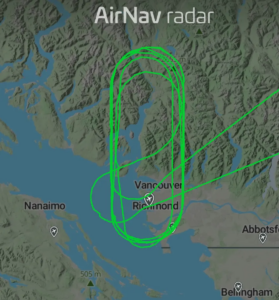
Open source map showing the flight of the U.S. Air Force stratoanker on June 3, 2026 over the Lower Mainland, as part of a pre-FIFA World Cup training exercise. (RadarBox)

NORAD, the joint Canada/U.S. North American Aerospace Defense Command, held its final Canadian exercise on June 3 above the Lower Mainland. Few, if any, morning commuters saw it, due to the overcast skies. But the Boeing KC-135 Stratotanker (tail number 63-8884) from Fairchild Air Force Base in Spokane, Wash., was particularly audible during its passes over the North Shore mountains and visible on open source flight tracker apps.

NORAD Capt. Raelyn Luchsinger told theBreaker.news that the exercise involved the tanker, a CF-18 fighter jet from the Royal Canadian Air Force’s 4 Wing Cold Lake and a civilian DHC-6 Twin Otter.

“The activity was related to preparations for upcoming World Cup activities in the region. Specifically, it was a [Canadian NORAD Region] live-fly activity conducted to validate airspace security procedures and coordination with federal partners, including Public Safety Canada and the RCMP,” Luchsinger said.

“Exercises such as this one enforce CANR’s preparedness to provide aerospace warning and aerospace control capabilities in support of those partners, should they be required.”

Last Oct. 28, theBreaker was first to report on NORAD’s World Cup-related exercise above Vancouver. Two RCAF CF-18s from the Comox base refuelled from the Stratotanker and returned to base. The refuelling jet has capacity for almost 91,000 kilograms of transfer fuel.

Other venues for the exercise included airspace between Toronto and Toledo, Ohio, and Monterrey, Mexico and Houston, Texas.

On July 15, 2025, NORAD scrambled F-15 fighter jets to handle a real incident when Shaheer Cassim hijacked a Cessna 172 from the Victoria Flying Club and interfered with YVR operations. Cassim, who called himself a “messenger of Allah” the day before on social media, pleaded guilty in April in Richmond Provincial Court.

Two Qatar Air Force Globemasters at Vancouver International Airport on May 30. (Mackin)

Last dress rehearsal

The June 3 exercise happened after a weekend visit from two Qatar Emiri air force Boeing C-17 Globemaster cargo jets. They flew in from London Stansted carrying World Cup-related cargo and personnel.

theBreaker found them parked side-by-side at Vancouver International Airport.

Qatar begins its World Cup on June 13 in San Francisco. Five days later in Vancouver, it meets host Canada.

Laurie Trautman, director of the Border Policy Research Institute at Western Washington University, said on theBreaker.news podcast that the Qatari delegation has informed U.S. Customs and Border Protection that it is planning a 56-motorcoach convoy from Vancouver to Seattle before the team’s third match, June 24 versus Bosnia and Hercegovniza.

During a mid-May trip to Doha, Canada’s foreign minister Anita Anand described Qatar and its Al Thani royal family as “friends, allies, partners.”

Drone threat

Vancouver Police Department graphic on the no-fly zones for drones during FIFA World Cup. (VPD)

One of the biggest security threats across all 16 cities: drones.

From aerial photography hobbyists to terrorists to soccer spies: Remember the 2024 Canadian women’s Olympic team scandal?

“Drones of any size will not be permitted within designated no-fly zones around” B.C. Place, Fan Festival site PNE and training sites Killarney Park and University of B.C., warned the Vancouver Police Department. The no-fly zones are one-nautical mile radius each, from ground to 2,500 feet above sea level, through July 19.

“Penalties can include significant fines, the seizure of your drone, and criminal charges.

theBreaker was first to report on a Feb. 4, 2025 presentation to federal assistant deputy ministers that prioritized airspace security and counter-unscrewed aircraft systems for tactical planning. The latter is meant to lawfully and safely disable or disrupt a drone.

Integrated Threat Assessment Centre warned that drones could be used to drop objects, such as “mock powder or other substances near a crowd to cause panic.”

Last December, the U.S. Federal Emergency Management Agency gave $250 million in grants to 11 states hosting matches to “to detect, identify, track or mitigate” drones.

“In recent years, criminals, terrorists, and hostile foreign actors have intensified their use of this technology,” said the FEMA news release.

“American law, Canadian law, slightly different,” said Deputy VPD Chief Don Chapman. “As a municipal police agency, I do not have the authority to bring down a drone. However that is a federal responsibility, so we would rely on our federal partners to do detection work or mitigate work.”

Not just about drones

Vancouver Police Deputy Chief Don Chapman. (Mackin)

Some civilian flights will be restricted for six hours on each game day in the Vancouver Harbour Control Zone, which includes Burrard Inlet, English Bay and False Creek.

“Civilian aircraft will only be approved if they are operating on an [instrument flight rules] flight plan, are a MEDEVAC flight, or are conducing a commercial flight authorized by the Vancouver Police Department,” said the Aeronautical Information Circular, published April 30.

The circular said congestion is expected in airspace above Vancouver International and Toronto Pearson International airports.

“This airspace risks becoming saturated due to a high density of arrivals and departures mixed with unscheduled general aviation or business aviation activity. Operational disruption from high volumes of flights could compromise scheduling, ground handling, and emergency response.”

Transport Canada spokesperson Sau Sau Liu said: “The public and visitors are also urged to follow the guidance of local authorities and to stay vigilant, as safety and security are a collective responsibility.”

Subscribe to theBreaker.news on Substack. Find out how: Click here.

Bob Mackin All eyes on the temporary, hybridgrass

For the week of June 7, 2026: 

On FIFA World Cup kickoff week, theBreaker.news visits the South Vancouver neighbourhood that said no to FIFA.

Friends of Memorial South Park successfully campaigned to stop closure of the heart of their park for use as a team training site — after the city’s FIFA hosting office announced in July 2024 that the space would be off-limits to the public for almost two years.

Host Bob Mackin caught-up with Cindy Heinrichs and Beth Ringdahl at Memorial South Park’s May 24 centennial celebration. Plus a tour of the park by local writer Rob Howatson.

CLICK BELOW to listen. Or go to TuneIn, Apple Podcasts or Spotify.

Have you missed an edition of theBreaker.news Podcast? Go to the archive.

Subscribe to theBreaker.news on Substack. Find out how: Click here.

theBreaker.news Podcast
thePodcast: The neighbourhood that said no to FIFA
Loading
/

For the week of June 7, 2026:  On

Bob Mackin

The ABC-controlled City of Vancouver and NDP provincial government are both refusing to say how much the province is spending on the $47.6 million FIFA Fan Festival.

But city hall is admitting its local World Cup sponsorship program will not meet its goal — almost a year after the province listed it as a risk and six months after Mayor Ken Sim’s party passed an election year property tax freeze.

Vancouver city hall’s FIFA World Cup host committee lead Jessie Adcock (left) and COO Taunya Geelhoed. (Mackin)

Last June, the province’s FIFA World Cup budget estimates identified the potential for “less-than-planned net revenue from the host city commercial program due to lower market demand.” In that report, the province estimated $50 million to $62 million in revenue from the city and parks board. On May 29, it said the range fell to $43 million to $53 million — a 14% decrease.

“The figures outlined above are driven by a projected decrease in sponsorship program revenue,” said a prepared statement, delivered via David Harrison of the host city office. “This revenue decrease is partially offset by an anticipated [$21.6 million] increase in FIFA Fan Festival Vancouver revenue.”

The city is hoping for $21.6 million revenue from food, beverage and tickets, leaving the net cost of the festival at $26 million.

Share

Ironically, Fan Festival site PNE is the only one of the nine host city supporters announced May 21 to disclose the top terms of its sponsorship: it is paying $0 and buying zero tickets to BC Place matches.

The host city agreement between FIFA and City of Vancouver said the Fan Festival is supposed to operate every day of the tournament, showing every match and no admission is to be charged.

Vancouver’s will operate on 28 of the 39 days. While it is free to enter the gates and watch matches on a big screen outdoors, reserved seats under the amphitheatre roof are $115.05 and up. Around 2,600 standing room freebies will be available on a first-come, first-served basis.

FIFA sells pitch access for selfies

FIFA has found even more ways to sell its most-expensive packages to World Cup matches, beginning next week.

In March, FIFA’s New York-based hospitality contractor On Location told a manager at B.C. Place Stadium in Vancouver that it was “excited” to offer host city clients “the opportunity to purchase the barstools and standing room only (SRO)” inside VIP suites.

“Please note that all barstools in a given suite must be purchased before an SRO can be purchased. SRO tickets do not guarantee a view of the pitch,” according to documents theBreaker obtained under freedom of information.

Suites for seven matches at B.C. Place appear to be sold out; the website contains “join waitlist” links.

Also, through its “elite and reserve packages,” On Location is selling post-match, on-pitch experiences: the team bench photo experience and penalty kick experience.

“Guests can visit the team benches post-match to experience the players’ perspective and take a memorable photo. Guests can take a penalty kick on the pitch, post-match.”

Prices were not mentioned in the email from On Location’s director of sales partnerships Stephen Sonkin, but the local host committee gets six complimentary passes for on-pitch activations.

The Vancouver host committee is spending $14.4 million of taxpayers’ money on tickets, lounges and suites. Phil Adams at taxpayer-owned B.C. Pavilion Corporation is acting as sales agent for City of Vancouver’s commercial program.

Subscribe to theBreaker.news on Substack. Find out how: Click here.

Bob Mackin The ABC-controlled City of Vancouver and

Bob Mackin

Regional rationing means lawn watering is temporarily banned in FIFA World Cup host city Vancouver beginning June 8.

But there is no danger the temporary hybrid grass pitch inside B.C. Place Stadium will turn brown before it hosts the first of seven matches on June 13.

Metro Vancouver issued the stage 3 conservation notice because of a low snowpack, forecasts for a dry summer and less drinking water from the North Shore getting through due to the Stanley Park water supply tunnel project.

“While this crossing is offline, the system has less flexibility during periods of very high water use,” Metro Vancouver said.

A statement from stadium management says staff work closely with City of Vancouver to adhere to municipal bylaws.

“As part of venue operations, water use for B.C. Place’s grass maintenance is acceptable under stage 3 restrictions of the Metro Vancouver Drinking Water Conservation Plan.”

Under stage 3, sand-based playing fields can be watered no more than five days in a seven-day period, between 7 p.m. and 9 a.m. For soil-based fields, the allowance is three days.

Now, onto your hump day headlines from the Pacific Rim and the Pacific Northwest.

Around the Rim

Taiwan News reports that two soldiers and a citizen were indicted over allegedly leaking military secrets to China via messaging apps. In return, they were paid in cryptocurrency.

One of those charged by prosecutors in Taoyuan is a sergeant and the other a private.

Taiwan News reports that “irregularities were discovered within the military unit and reported by the armed forces. After investigators gathered evidence, they carried out searches and detained the three suspects, later securing court approval for pretrial detention without visitation rights.”

Could Japan be the next country to regulate the age of social media users?

A draft report said social media companies must perform stricter age verification, but the communications ministry panel said a “blanket age-based ban” may not be appropriate.

Why? “The role of social media as an important communication tool,” according to the story in Kyodo News.

The goal is to “reduce youth dependency on such services to mitigate the burden on their mental and physical health.”

Amazon, eBay and Chinese e-commerce sites Temu and AllExpress are selling banned kids products in Australia, according to ABC News Australia.

“These include fake novelty cigarettes that create a puff of smoke, cigarette lighters that look like toys and removable tongue studs that can easily come loose and become choking hazard.

Also of serious concern are flammable garments and products containing small choking hazards and potentially deadly button batteries, which may be in breach of safety standards.”

Consumer group CHOICE complained to the Australian consumer watchdog and is urging the government to act against sellers of dangerous goods.

Cascadia Calling

No, this is not from the satirical series Portlandia.

The Oregonian reports that sportswear company Patagonia and drag queen Pattie Gonia could be closer to a trademark settlement. The Bend drag queen offered to drop a trademark application if Patagonia drops its lawsuit.

Patagonia said it wants Pattie Gonia to also “stop using our logos” and “stop selling and promoting apparel and other products as Pattie Gonia.”

Also in the Oregonian, Portland city council is mulling whether to make magic mushrooms a “low police priority.”

“It would also establish the Portland Psychedelics Advisory Commission as an advisory body to make recommendations to the city on public education and harm reduction.”

Commercial real estate woes in Seattle, as Blackstone is looking to sell the US Bank Center at a 54% loss, reports the Seattle Times.

That would be $280 million or less than half it paid for the 44-storey tower seven years ago. Spear Street Capital has agreed to buy the tower.

“Central business district office values have fallen 44% on average in the past five years, according to analytics company MSCI,” said the story, which originated in Bloomberg.

Meanwhile, up in Bellingham, Ron Judd is out at the Cascadia Daily News.

Judd, a guest on theBreaker.news podcast before the 2024 presidential election and in May 2025, was executive editor of the independent newspaper since its 2022 launch.

CDN reported that Judd was fired May 26 by owner David Syre over a dispute about the launch of a new quarterly magazine, Cascadia Daily Life.

CDN covered the firing and later published an ode to Judd, a former Seattle Times reporter and columnist.

He is always welcome to be a guest on theBreaker.news podcast.

Subscribe to theBreaker.news on Substack. Find out how: Click here.

Bob Mackin Regional rationing means lawn watering is

Bob Mackin

The week before the FIFA World Cup kicks off, the Toronto Police Service (TPS) says it scored the “largest known seizure of counterfeit soccer jerseys in Canadian history.”

But it is not the first fake operation to piggyback on a major international sporting event in Canada.

Toronto Police Service shows-off items from a Mississauga anti-counterfeit bust. (TPS/YouTube)

TPS said June 1 that it searched the Amana Trading warehouse in Mississauga on May 26 and found 16,000 fraudulent jerseys and flags worth $3.5 million. The items purported to be FIFA, Nike, Adidas and Puma-branded. Ramy Jaber, 41, of Milton, Ont., and Walid Sarhan, 62, of Mississauga, were charged with fraud over $5,000, possession of property obtained by crime over $5,000 and intent to deceive. Next court date is Aug. 17.

Toronto lawyer Lorne Lipkus’s intellectual property firm received a tip about Amana and reported it to TPS. The company has been on Lipkus’s radar for a while. He represented New Era Cap LLC in a 2024 Federal Court trademark infringement filing against Jaber, Khuloud Hamdallah and Sports United, which is related to Amana.

Vancouver 2010

Lipkus was also involved in battling counterfeiting around the Vancouver 2010 Winter Olympics. Back in 2010, there were 1,500 shipments representing 16,000 counterfeit, mostly Team Canada jerseys intercepted by the RCMP and Canada Border Services Agency over two weeks at the Vancouver mail processing plant. The haul was more than $2.3 million.

Dale Ptycia, the senior manager of licensing for Hockey Canada, testified to the House of Commons standing committee on industry, science and technology in November 2013.

“We estimated that less than 10% to 20% was intercepted of the actual number of counterfeit jerseys imported into Canada leading up to and during the Games,” Ptycia told the committee. “This translates into more than 250,000 jerseys that were imported into Canada, with a retail value of over $32.5 million—all lost revenue, which negatively impacts Hockey Canada.”

Share

In the Toronto soccer case, it is about one company importing goods and distributing them to retailers.

“Generally the goods like this come from Asia, and not solely from China, but the majority of it from China, and I wouldn’t expect this would be any different,” Lipkus told theBreaker. “It is not likely made in Canada. I can also tell you, that in the last several months we’ve seen a huge uptick in counterfeit soccer jerseys being imported into Canada and being sold in Canada. So the fact that we now have a seizure by the police of this size is not something that is surprising. There’s just so much money to be made.”

Toronto anti-counterfeit lawyer Lorne Lipkus. (Lipkus Law)

Evolution

Lipkus said counterfeiting has evolved since Vancouver 2010 due to technology and consumer trends. Fewer national retail chains selling legitimate products. More online retailers. Some of them with ill intent.

“Where we had flea markets before, we now have the Internet, and the Internet is more than just the flea market of the present or the flea market of the future,” Lipkus said. “It’s a much more sophisticated and easier way to do business.”

Lipkus said scammers are using artificial intelligence to create fraudulent online sales channels. But investigators are also using AI to catch scammers quicker.

“Our firm has four full-time online investigators, and almost every brand we represent —and we represent over 200 brands — and I would say most of them or all have people helping them online, because that’s where the sales are taking place, and a lot of the counterfeits are taking place. Not only in marketplaces, like Temu and Amazon, you can name all of them, they all have to be checked very carefully. They may have vendors, but they have very sophisticated programs to allow brands to take down the advertisements, to prevent the sale of counterfeits of their product from various sellers. So it’s evolved in that way.”

Why it matters

Generally, counterfeiting of licensed clothing often involves the use of sweatshop labour, money laundering and tax evasion. It is too early to tell in this case.

Clothing knockoffs can even pose danger to consumers, due to toxic or flammable materials.

The European Union Intellectual Property Office and Organization for Economic Co-operation and Development estimated in 2021 that the global market for counterfeit sportswear was worth almost $725 billion.

Subscribe to theBreaker.news on Substack. Find out how: Click here.

Bob Mackin The week before the FIFA World

For the week of May 31, 2026: 

The day after the B.C. NDP government ended the spring Legislature session by weakening the freedom of information law, two of Premier David Eby’s ministers revealed the cost of co-hosting FIFA World Cup in Vancouver could be as much as $729 million.

On this edition of thePodcast, highlights of the news conference held by Anne Kang, Minister of Tourism, Arts, Culture and Sports, and Ravi Kahlon, Minister of Jobs and Economic Generation (starting at 00:50).

Plus reaction from Carson Binda, the B.C. director of the Canadian Taxpayers Federation who remembers when the cost was supposed to be $230 million (starting at 08:40). 

Vancouver and Seattle are the closest cross-border host cities of the Canada/U.S./Mexico tournament. Prof. Laurie Trautman, director of the Border Policy Research Institute at Western Washington University, on the regional tourism, transportation and security implications (starting at 16:24).

CLICK BELOW to listen. Or go to TuneIn, Apple Podcasts or Spotify.

Have you missed an edition of theBreaker.news Podcast? Go to the archive.

Subscribe to theBreaker.news on Substack. Find out how: Click here.

theBreaker.news Podcast
thePodcast: Cup costs, controversy and Cascadia connections
Loading
/

For the week of May 31, 2026:  The

Bob Mackin

The cost of FIFA World Cup security in Vancouver is now in the range of the original, all-in cost for hosting.

In a May 29 budget update, timed by the NDP government for the day after the Legislature session ended, $242 million is the new estimate.

When Vancouver was named one of the 16 co-hosts in 2022, the NDP government said hosting could cost $240 million to $260 million. But FIFA-demanded stadium renovation, the expanded schedule, scope creep and inflation drove-up the total price, now expected to be as high as $729 million.

The April 30 FIFA Congress in Vancouver was a a preview of World Cup security spending. (Mackin)

“Cost estimates will continue to evolve in response to world events and other FIFA factors,” said a presentation to reporters.

The province assumes that the 2023-imposed 2.5% accommodation tax, only in City of Vancouver, will collect $250 million to $260 million by its expiry in early 2030. That revenue stream was originally supposed to cover the entire cost of hosting. In 2023, FIFA expanded the tournament from 80 to 104 matches and B.C. Place Stadium was given two more matches than expected.

The province says it has collected $105.7 million on behalf of Vancouver as of the end of March.

In the June 2025 estimates, the total cost was expected to be as high as $624 million and City of Vancouver and the Park Board’s estimated revenue contribution was $50 million to $62 million.

The new version lowers the expectation, to between $43 million and $53 million.

Asked about the 14% decrease, David Harrison of the city’s host committee office said that is because of a “a projected decrease in sponsorship program revenue. This revenue decrease is partially offset by an anticipated increase in FIFA Fan Festival Vancouver revenue.”

Share

With three weeks to go, the city announced nine host city supporters under the sponsorship program. One of those supporters, the PNE, told theBreaker that it paid nothing to be part of the program and is not buying any match tickets from the city’s $14.4 million inventory.

The 2025 update’s section on risks identified the potential for “less-than-planned net revenue from the host city commercial program due to lower market demand.”

The report said the Fan Festival’s net cost is $26 million. But Harrison later said the gross cost is $47.6 million and funding is provided “through a collaborative partnership involving multiple contributing organizations.”

He did not provide the breakdown, but all signs point to the province taking a bigger role at an event that was supposed to be solely city-delivered.

He said revenue is projected at $21.6 million from food, beverage and ticket sales.

Is the true cost closer to $1 billion?

Adding the PNE Amphitheatre to the running tally would bring World Cup costs to as much as $912 million.

The $183 million centrepiece of the Fan Festival must be completed on a timeline to fulfil that duty beginning June 11. While gate admission is free to the Fan Festival, the reserved seating under the big roof is not.

In 2006, when B.C.’s Office of the Auditor General analyzed costs to build and operate the Vancouver 2010 Winter Olympics, it cited the Government of New South Wales’ definition for the costs of the Sydney 2000 Summer Olympics: “costs directly related to, or incurred in meeting, the obligations of the host city contract.”

“The investment into the amphitheatre by the city of Vancouver and the need for that is going to have a legacy well beyond the games,” Kahlon said. “I wouldn’t say that it was built for the World Cup, but it’s been built for bringing more tourists and more economic opportunities to the PNE grounds. It’s going to have a legacy for years into the future.”

The World Cup happens at a time when the province has a record deficit and the NDP government has cancelled expansion at Burnaby Hospital and several projects for seniors housing. Yet, Kahlon and Kang continued to repeat the vague five-year forecast of $1 billion more revenue and 1 million more tourists due to the World Cup.

“We need to continue to find opportunities to grow the economy, so that we can provide long-term care opportunities, expand our health care, expand the opportunities for education for young people,” said Jobs Minister Ravi Kahlon. “We need to do both, and that’s what this initiative is about.”

NDP ducking accountability, transparency

Carson Binda, B.C. director of the Canadian Taxpayers Federation, said costs have skyrocketed 217%.

He also said the NDP government is dodging accountability with World Cup spending and making it harder for British Columbia journalists, taxpayers and advocates to get documents. The government’s amendments to water down the freedom of information law were passed on the final day of the Legislature session.

“Releasing these newest cost figures just a day after the legislative session closes is a naked attempt to avoid accountability,” Binda said. “David Eby didn’t want to be questioned about these dramatic cost overruns in question period.”

The province gave reporters a 19-page Powerpoint presentation and a seven-page summary, but those were not sufficient, Binda said.

“We need to see what the business plan is, what the line-by-line spending is, how our money is being used at the end of the day,” he said. “There’s no reason for the government to be withholding those kinds of documents, if they exist at all.”

Subscribe to theBreaker.news on Substack. Find out how: Click here.


Bob Mackin The cost of FIFA World Cup

Bob Mackin

The B.C. NDP government is updating British Columbians May 29 on the cost of hosting seven FIFA World Cup matches. More than 11 months since the last time and, conveniently, the Friday after the Legislature closed until September.

It is never a good sign when a government steadfastly holds onto a spending report in such a fashion. Clearly, it did not want to give the ball to the opposition Conservatives, Greens or an independent to score an easy one in the last Question Period until September.

Five storylines to watch.

Premier David Eby (right) and FIFA Canada’s Peter Montopoli with a giant, inflated Adidas Trionda World Cup ball on March 31, 2026 in Victoria. (BC Gov/Flickr)

1. The costs

Last year’s estimated range: $524 million to $624 million.

Mega-event spending is never static. It only goes up.

Rewind four years to March 2022, when it was supposed to cost $240 million to $260 million.

Is it now officially around $800 million?

Inflation, labour and supply line risks have increased, same with safety and security requirements. None of those got any cheaper. Statistics Canada said the country slipped into a technical recession in 2026’s first quarter.

Should it be closer to $1 billion, if the PNE Amphitheatre is added to the bill?

Rewind to 2006, when B.C.’s Office of the Auditor General analyzed costs to build and operate the Vancouver 2010 Winter Olympics. It cited the Government of New South Wales’ definition for the Sydney 2000 Summer Olympics: “costs directly related to, or incurred in meeting, the obligations of the host city contract.”

City of Vancouver is building the $183 million PNE Amphitheatre (to be known as the Freedom Mobile Arch) and its first and biggest assignment is being the centrepiece of the FIFA Fan Festival watch parties and concerts.

After Vancouver froze property taxes and cut services in this year’s budget, the province has taken a bigger role in Fan Festival operations.

2. The benefits

From the B.C. government’s 2025 report on FIFA World Cup estimates.

The government has assumed 350,000 visitors to B.C. Place — all seven matches sold out.

The dominant storyline for FIFA 26 is high ticket pricing, which has scared some tourists away. FIFA cancelled bulk hotel bookings and hoteliers say June 2026 reservations are trending below June 2025. FIFA was supposed to be a bonanza.

The NDP government — unscientifically — claimed the World Cup would help bring $1 billion more spending over the next five years and draw another million tourists.

Victor Matheson, an economics professor at the College of the Holy Cross in Massachusetts, studies mega-events. He found that they “simply supplant, rather than supplement the regular tourist economy.”

“In other words, the economic impact of a mega-event may be large in a gross sense but the net impact may be small,” Matheson concluded.

3. The draw: a dud or a sleeper?

Last year’s report said a $145 million contingency was included, because a wide range of risks were contemplated.

Top of the list was the tournament draw. In December, FIFA assigned Australia, Belgium, Egypt, New Zealand, Qatar, Switzerland and Turkey to Vancouver. (We already knew Canada would play twice.) The first round is populated by soccer “minnows.”

The X-factor: will the opponents in the two knockout round games on July 2 and 7 be one or more of the highly desired European or South American past champions?

4. Lukewarm local sponsorship

The province’s 2025 estimates cautioned about “less-than-planned net revenue from the host city commercial Program due to lower market demand.”

For the first time, FIFA granted host cities up to 10 local sponsor slots, who also get front-of-the-line access to tickets, lounges and suites. The catch: none could directly compete with an existing FIFA partner.

Nine local sponsors were announced on May 21. The PNE, site of the Fan Festival, is one of them. The only one that admitted terms of its contract, which is $0 paid and zero tickets to be bought from City of Vancouver’s inventory of 7,400, worth $14.4 million.

Rather than a revenue bonanza, did the local sponsors help Vancouver control costs?

5. Federal “partnership”?

The 2025 report anticipated Ottawa would become a “full partner helping to manage and fund extraordinary risks that materialize for the FIFA World Cup 26 event, such as potential global economic downturns, natural disasters like fires and floods and increasing threat levels from rising geopolitical tensions.”

At the time, it had given only $220 million, split between Vancouver and Toronto. Last November’s budget provided $100 million for federal services. Secretary of State for Sport Adam van Koeverden came to Vancouver for the FIFA Congress at the end of April to announce another $145 million for safety and security.

Sources say the increased federal funding was welcome, but still not enough.

Subscribe to theBreaker.news on Substack. Find out how: Click here.


Bob Mackin The B.C. NDP government is updating

Bob Mackin

Did Vancouver city hall’s World Cup host committee score any revenue under FIFA’s new local sponsorship program?

On May 21, City of Vancouver announced Musqueam, Squamish and Tsleil-Waututh first nations, Concord Pacific, Coke Bottling Canada, Bell, TransLink, Science World and PNE as “Host City Supporters.” Each one had a pre-existing relationship with city hall and/or FIFA.

Five of the host city supporters responded to theBreaker.news, but only one — the site of the FIFA Fan Festival — commented on the terms of its agreement.

“We are spending $0 to be a part of the program,” said PNE spokesperson Laura Ballance. “We are getting our logo listed whenever FIFA host committee mentions host city supporters. We are getting zero tickets and zero suites for being a host city supporter.”

Bell, parent of official broadcasters CTV and TSN, would not disclose details. Spokesperson Éliane Légaré.said the company’s roles are “delivering advanced network connectivity to supporting fan experiences across the city.”

Representatives of the Squamish Nation, Musqueam Indian Band and Science World refused to comment and referred questions to City of Vancouver.

Won’t be 10

Each host committee is allowed up to 10 local supporters, but none can directly compete with an existing FIFA partner.

“We do not anticipate any additional host city supporters being announced,” said David Harrison of the host committee office.

The supporters contribute money and/or budget-relieving goods or services, FIFA does not set the values of the agreements and they do not follow a uniform pricing model, Harrison said.

“Each supporter’s’ level and form of contribution varies, and the individual partnership arrangements are confidential.”

Share

Science World, undergoing a transformation into a giant Adidas Trionda World Cup ball. (Mackin)

Risks and uncertainties

City hall spent $14.4 million to buy 7,400 tickets, lounges and suites for resale under the host city supporters and host city champions programs. It has not disclosed results.

In the B.C. government’s June 2025 World Cup budget estimates, one of the “risks and uncertainties” was “less-than-planned net revenue from the host city commercial program due to lower market demand.” The report did not forecast the program’s net revenue.

The NDP government is expected to release a budget update after the spring Legislative session closes May 28.

Ontario deal

In Toronto, the host committee signed up Humber Polytechnic, Ontario Lottery and Gaming Corporation, Ontario Power Generation (OPG) and Toronto FC.

OPG’s April 2025 agreement, obtained by theBreaker.news under freedom of information, includes a partly censored clause about tickets. Tickets acquired by a host city supporter may not be used for promotional purposes and can only be allocated to bona fide, privately invited guests. FIFA reserves the right to cancel any tickets issued or purchased and/or withhold ticket allocations.

The deal included brand recognition at the one-year countdown last June and the 100-day countdown in March, premium access to the tournament draw viewing party in December and the FIFA World Cup trophy tour in May. Also, access to “an Ontario-restricted media package comprised of television, radio, digital advertising, or out-of-home advertising valued at $250,000.”

The deal tightly regulates how the supporter can communicate about being a supporter — specifically, not without FIFA and host committee approval. The supporter shall avoid any unethical conduct and not do anything to embarrass FIFA or jeopardize its reputation.

Subscribe to theBreaker.news on Substack. Find out how: Click here.

Bob Mackin Did Vancouver city hall’s World Cup

Bob Mackin

Vancouver city hall has spent more than it budgeted for access to FIFA World Cup matches at B.C. Place Stadium.

Last July, theBreaker.news reported that City of Vancouver set aside $13.4 million to buy seats, suites and lounges from FIFA contractor On Location. The New York company is led by Donald Trump’s former agent Ari Emanuel and its minority shareholders include Trump’s Secretary of Education, Linda McMahon.

On May 25, the host committee told theBreaker.news that it spent $14.4 million on “purchased assets.”

Vancouver City Hall, dressed in FIFA World Cup colours and logo, and the Capt. George Vancouver statue. (Mackin)

City hall holds approximately 9,000 tickets — a mix of general admission and suite and lounge tickets. Of these, 1,600 were provided under the host city agreement and 7,400 were bought by the city.

The host committee says that, of the 7,400 purchased, approximately 4,700 reserved seating tickets were via the option to buy 1.5% of B.C. Place Stadium capacity.

The majority held by the city are being sold via the local market sponsorship program, but details of the program’s sales are “commercially sensitive and therefore at this time confidential.”

Share

Under the FIFA-approved, Host City Supporters/Host City Champions regional sponsorship program, hospitality packages are for sale beginning at $195,000.

The city plans to allocate 216 tickets to value-in-kind trades or other beneficial uses, 350 for community youth and children’s groups and 56 for hosting partners, such as Vancouver International Airport.

In New York, Mayor Zohran Mamdani campaigned against exorbitant ticket prices. He negotiated with the host committee to put 1,000 tickets on sale to matches in New Jersey for $50 each via lottery.

TKO

TKO Group Holdings Ltd., parent company of On Location, reported that it “significantly exceeded” previous World Cup hospitality sales in June 2025, a year before the event.

On May 6, it told shareholders that “approximately USD$582.4 million of net pre-payments held in escrow related to FIFA World Cup 26.”

Directors include Jonathan Kraft, co-owner of FIFA 26 venue Gillette Stadium via the Kraft Group.

FOI

When theBreaker.news asked to see invoices last year, City of Vancouver provided censored pages. A complaint to B.C.’s Office of the Information and Privacy Commissioner is proceeding to an adjudicated inquiry.

In the city’s 2025 statement of financial information, it reported paying On Location $600,386. It refuses to say how much it has spent in 2026 so far.

Subscribe to theBreaker.news on Substack. Find out how: Click here.

Bob Mackin Vancouver city hall has spent more